
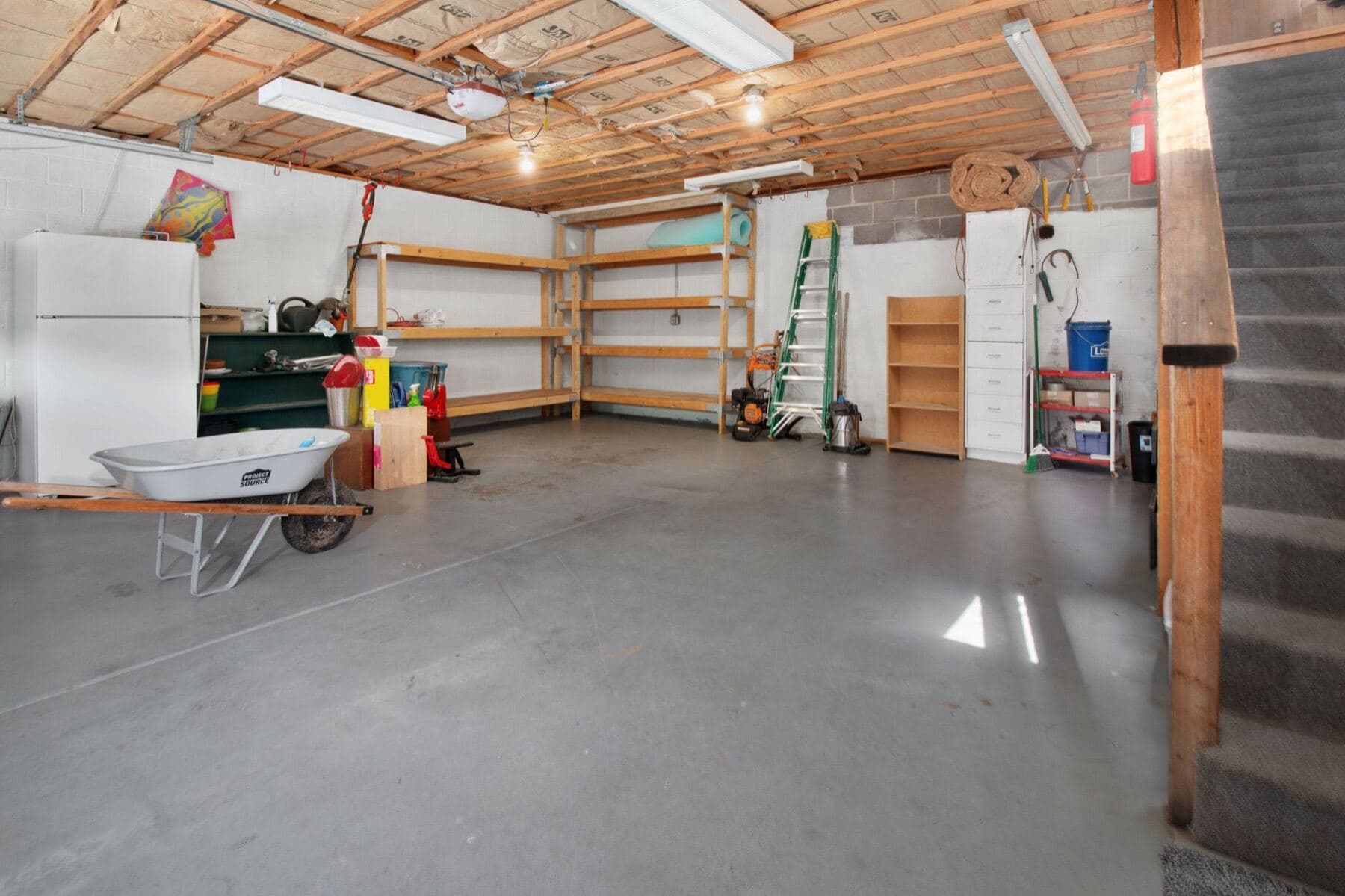
A coating that peels was almost never a bad product. It was a decision made before the first pail was opened. There are four common failure modes and you can usually tell them apart by looking at what came off.
1. It was never mechanically bonded
This is the big one. Concrete has a weak, dusty, sometimes contaminated layer at the very top called laitance. A coating applied over it is bonded to laitance, not to concrete, and the whole floor is only as strong as that layer.
Acid etching is supposed to remove it. In practice, on a garage slab that has had cars on it for twenty years, etching barely touches oil-saturated areas and leaves an inconsistent profile everywhere else. Diamond grinding removes the layer mechanically and leaves an open, uniform profile across the whole floor.
How to spot it: the coating comes off in large sheets and there is grey powder or a smooth, closed concrete surface on the back of it. If the failed piece looks like a sticker peeled off glass, it never keyed in.
2. Vapour pressure pushed it off
Moisture moving up through the slab arrives under the film and cannot get out. Given time and enough pressure it lifts the coating from below, often starting in the middle of a bay rather than at an edge.
This is the failure mode that older Victoria garages are most prone to, because slabs poured before vapour barriers became standard have nothing under them. It is entirely preventable with a moisture reading and a mitigating primer.
How to spot it: blisters or bubbles that appear before anything mechanical touched the floor, often damp underneath when you break one open, and failure starting in open floor areas rather than at doorways.
3. Contamination that was coated over
Oil, brake fluid, transmission fluid and tyre plasticiser soak into concrete and do not wash off. Coating over a contaminated patch produces a floor that is fine everywhere except exactly where the car sat, which is exactly where you will notice it.
Proper treatment is degreasing and then grinding deep enough to get past the saturation, and occasionally accepting that a badly soaked area needs cutting out. It is not a step that can be skipped by using a better product.
How to spot it: failure in discrete patches, usually two wheel-width apart, in the parking positions, with the rest of the floor sound.
4. It was applied outside its window
Every coating has conditions: a temperature range, a humidity range, a pot life and a recoat window. Apply epoxy too cold and it never fully cures. Recoat outside the window and the layers do not chemically bond to each other, so the topcoat delaminates from the base while the base stays stuck to the floor.
In an unheated Victoria garage in the winter this is a genuine constraint, not a technicality, and it is a reason to be sceptical of a very fast turnaround in February.
How to spot it: only the top layer comes off, and the layer beneath it is still bonded, intact and the wrong colour to be the floor.
What to ask before you sign
Three questions, and the answers tell you nearly everything about a quote.
- How are you preparing the slab, and is grinding itemised on the estimate?
- Are you taking a moisture reading, and does the number go on the estimate?
- What is the recoat window, and what happens if the weather moves?
A quote that is materially cheaper than the others is usually cheaper on the first answer. Our full sequence is on the garage floor epoxy page, and if you already have a failing floor, it can be ground off and rebuilt rather than coated over.