
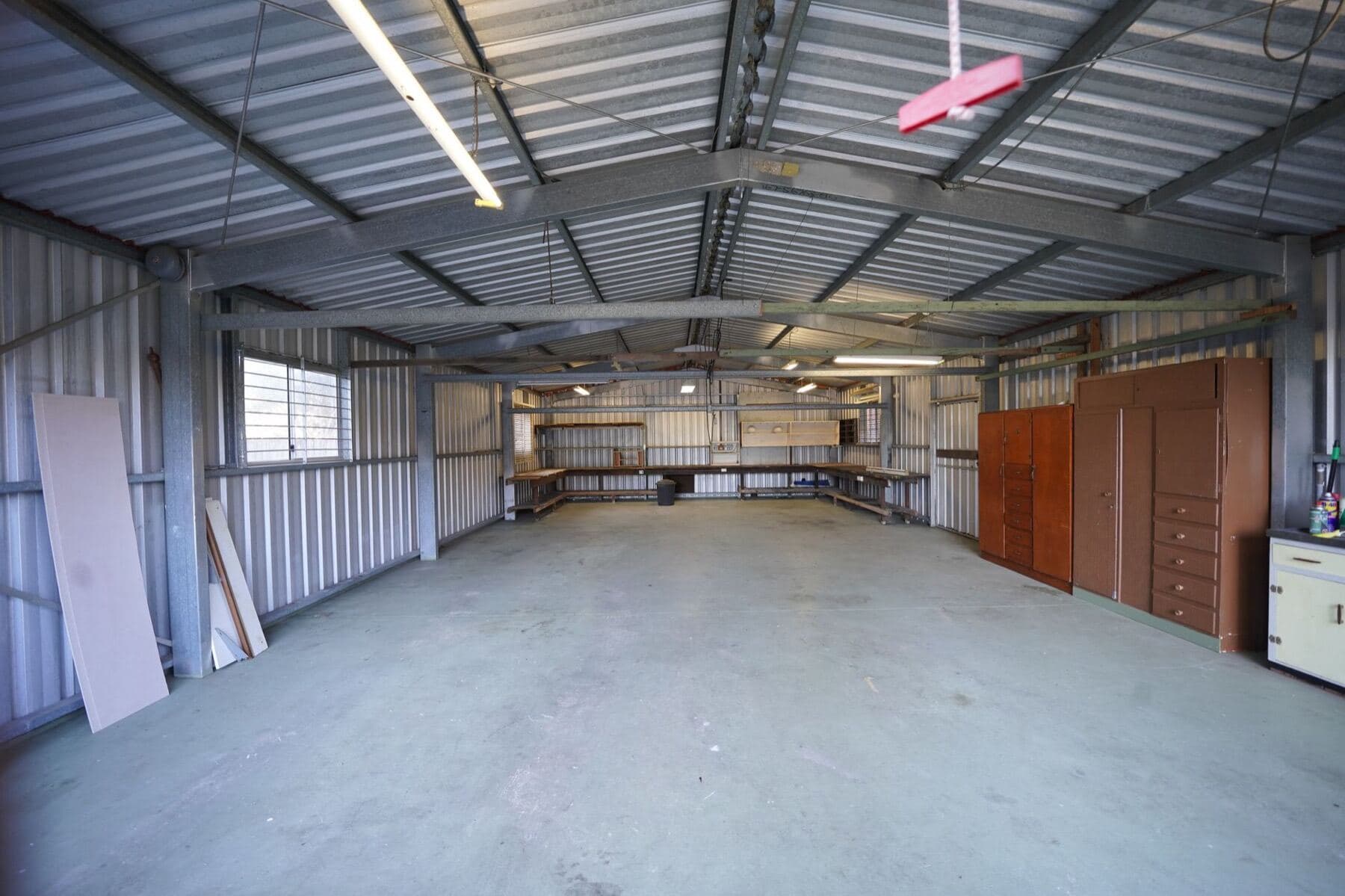
If somebody quotes your garage floor without testing it, they are quoting a floor they have assumed something about. On the South Island that assumption fails often enough to be the single most common cause of a coating lifting.
What the test is measuring
Not whether the slab feels dry. Concrete is porous, and in most residential garages the slab sits directly on ground that is wet for eight months a year. Water vapour moves up through the slab continuously, and it has to go somewhere. On an uncoated floor it evaporates off the surface and you never notice. Put a film over it and the vapour arrives at the underside of that film with real pressure behind it.
A moisture test measures how much vapour is coming through. The two common methods are a relative humidity probe drilled into the slab, which reads the humidity at depth inside the concrete, and a calcium chloride test, which sits a measured dish on the surface under a sealed dome and weighs how much moisture it picks up over a set period. The probe is generally the better indicator of what is happening below the surface.
What a bad number means
It does not mean no coating. It means a different coating.
- A low reading. Standard system. Prime, build, topcoat.
- A high reading. The floor gets a moisture-mitigating primer, a dedicated product designed to take vapour pressure and give the rest of the system something stable to sit on. It adds cost and a step, and it is not optional when the number says so.
- A very high reading, or standing water. Something else is wrong. A failed perimeter drain, grade running toward the slab, a downpipe discharging next to the foundation. Coating over that is spending money on a symptom. We will tell you to sort the water first.
Why older Victoria garages fail it so often
Polyethylene vapour barriers under residential slabs did not become standard practice until well into the 1970s. A great deal of the housing stock in Victoria, Oak Bay and the older parts of Saanich predates that. Those slabs were poured straight onto gravel or onto undisturbed soil, so there is nothing between the ground and your garage floor.
Add a climate that delivers most of its rainfall between October and March and a water table that sits high through the winter, and you have a slab that is doing a slow, continuous job of moving moisture upward. That is not a defect. It is how it was built, and it is entirely workable, as long as somebody measured it before they specified a system.
Can you check it yourself before booking
Roughly, yes, and it is worth doing. Tape a square of clear plastic sheet, around half a metre a side, tightly to the bare slab on all four edges. Leave it for a day or two. If condensation forms on the underside of the plastic, or the concrete under it darkens noticeably compared to the concrete around it, moisture is moving.
That test tells you there is something to talk about. It does not give a number, and the number is what decides the primer, so it does not replace the real test. But if the plastic comes up wet and a contractor quotes you without testing, you now know exactly what question to ask.
Where it sits in our process
The reading happens at the site assessment, before the estimate is written, and the number goes on the estimate along with the system it dictates. If the reading says the slab is not ready, the estimate says so and gives you the alternative, rather than quietly proceeding and hoping.
More on the systems themselves in epoxy vs polyaspartic, and on the failure modes in why coatings peel. The full process is on the garage floor epoxy page.